Sunday, June 10, 2018

Is ancient India Over rated?

Is ancient India overrated ?
A mindblowing analysis by Chinese Ex Professor from University of Toronto

https://postcard.news/is-ancient-india-overrated-a-mindblowing-analysis-by-chinese-professor-from-university-of-toronto/

https://postcard.news/is-ancient-india-overrated-a-mindblowing-analysis-by-chinese-ex-professor-from-university-of-toronto-part-2/amp/?__twitter_impression=true

Tuesday, March 27, 2018

Flutter and Android : Error running Gradle flutter doctor --android-licenses


Got below error when running 1st app developed using Flutter and Android Studio SDK

ERROR:
Error running Gradle: 
Unable to download needed Android SDK components, as the following licenses have not been accepted: Android SDK Build-Tools 26.0.2

Ran below command as told in the log.
flutter doctor --android-licenses

Got below error.
sdkmanager --version failed: 1

FIX:
Go to Android Studio and click on SDK Manager icon


Select version mention in the error and click on Apply


Once done run your application again.

Thursday, June 30, 2016

How to View Request Output Of Other Users

Set Profile Concurrent:Report Access Level for the user "Responsibility"

Setting this profile will allow you to see output submitted by other user in respective responsibility.

Reference : http://abhayappssolution.blogspot.com/2012/11/view-other-users-request-output.html

Sunday, April 10, 2016

Oracle EBS 12.2.5.1 Missing Responsibilities


In Oracle EBS 12.2.5 Oracle has provided Model Personalization feature. If you give incorrect Instance Name while creating Model Personalization for OAF Page OANavigatePortletAM  (Announcement) you may lose the Responsibility List.
If you see the error log, you may get errors like JBO-25005: Object name View Instance Name for type View Object is invalid

During Model Personalization JDR_ATTRIBUTES, JDR_COMPONENTS, JDR_PATHS tables gets updated.
You can find out your pesonalizations using below query.
Is There A Way To List All Personalizations In An Environment? (Doc ID 1332032.1)

SELECT PATH.PATH_DOCID PERZ_DOC_ID,
jdr_mds_internal.getdocumentname(PATH.PATH_DOCID) PERZ_DOC_PATH
,PATH.*
FROM JDR_PATHS PATH
WHERE PATH.PATH_DOCID IN
(SELECT DISTINCT COMP_DOCID FROM JDR_COMPONENTS
WHERE COMP_SEQ = 0 AND COMP_ELEMENT = 'customization'
AND COMP_ID IS NULL)
ORDER BY creation_date desc,PERZ_DOC_PATH;

If your Model Personalization is incorrect and JDR_ATTRIBUTES shows 'Activated' equal to 'Y' then there is no way you can fix this error from front end. First set 'Activated' equal to 'N'. Then you will be able to login into EBS successfully. Then you can go to  Model Personalization and delete it from the application.

Oracle E-Business Suite Release 12.2.5 Highlights


      In Aug 2015 Oracle released EBS 12.2.5.1    
      Below Video’s  shows Oracle E-Business Suite Release 12.2.5 Highlights


      Profile FND: Disable Navigator and Favorites Rich Menu setting it to False enables Global Navigator icon.


     With this profile setting you can get new cloud based look on EBS home page. Click on adds Favorite to add new forms as an apps

Sunday, February 28, 2016

Role Model / Strong Purpose or Desire Is Must to vision Your life

Kid who want to become cricketer, If you ask him who is your role model they will name Sachin Tendulkar in a fraction of second.

Kid who want to becone singer he will say Lata Mangeshkar, Kishor Kumar, Rafi.

Kid who want to become actor will say Amitabh Bacahan.

If someone want to make career in Investing there role model is Warren Buffet.

If someone want to become scientist therr role model is Einstine, Newton, Tesla and lot.

Where is the role model for BCom, BE students?
Most of the BCom student don't know what to do after BCom.

Those who are working as a clark, there is no role model for them because to become CFO you need to be CA or MBA.

Most of the people don't know who is role model  in there career stream of job. They lack the vision and they don't have anyone  who can show them where he can be if he follows his teaching, thinking,  ways to achive goals.

Every BSC, BCOM, BA, BE, MBBS, MBA student should have some role model or some desire to do something different, then only they can make progress in there life.

Otherwise after working few years into Industry they will get stuck at some level and will not be satisfied with there job.

So whether you are in college or college pass out identify your area of passion and find out who is role model into that area and have vision for life.

Friday, June 05, 2015

How to create Parameterzied View?

Here is the simplest way to create Parameterzied view.

CREATE OR REPLACE VIEW xxdd_mtl_serial_numbers
AS
SELECT *
FROM mtl_serial_numbers
WHERE serial_number in ( USERENV ('client_info'));

exec dbms_application_info.set_client_info('49236920');


select * from xxdd_mtl_serial_numbers

Friday, January 09, 2015

ODI 12c RKM E-Business Suite does not pull Synonyms

When I ran RKM E-Business Suite in ODI to pull all %INTERFACE% tables it did not pull tables like MTL_SYSTEM_ITEMS_INTERFACE which is own by INV Schema.

If you run below query you can see that Oracle added # at the end in all_synonyms.table_name column for MTL_SYSTEM_ITEMS_INTERFACE#

select * from   all_synonyms where table_name  LIKE 'MTL%SYS%ITEM%INTERFACE%'

This was creating problem in all the RKM E-Business Suite queries which was using all_synonyms table.

After changing join t.table_name = syn.table_name to  t.table_name = rtrim(syn.table_name,'#') in RKM E-Business Suite Knowledge Module-->Task issue got resolved.

Wednesday, December 24, 2014

GST and its Impact on India's Consumer, Manufacturing, Service Sector, State and Central Government

Introduction of GST in India is going to be big boom for domestic IT industry. Tax software will need changes to handle tax credit feature introduced by GST. For export of goods or services there will be GST at the rate of 0%. This is going to impact on Inter-Company transactions setup done in existing Oracle EBS and Hyperion and all tax related setup.

Companies will have to create new account to keep track of GST related transaction. Lot of existing central and state taxes need to be end dated and changes need to be done in tax rules for items which are tax exempt. Petrol, alcoholic liquor for human consumption will still have all the taxes but no GST. Tobacco and tobacco products would be subject to GST. In addition, the Center could continue to levy Central Excise duty and the States to levy sales tax / VAT.

Abolition of Octroi will reduce lead time for procurement. That will trigger some changes into Oracle EBS such as updating lead time and replenishment of stock level.  Companies might reduce there number of warehouses because of tax saving and increased supply chain efficiency.

Government has created a Goods and Service Tax Network (GSTN), the quasi-government company ( http://gstn.org/) and is in the process of finalising the tender for selecting a managed service provider an IT firm to which a majority of the mandate will be outsourced.

Read More: http://www.business-standard.com/article/economy-policy/gst-to-snap-up-it-talent-from-the-pvt-sector-114121900421_1.html

This generated my interest into learning more about GST and result of that is this blog post. 

Goods and Service Tax (GST) is India’s biggest indirect tax reform since 1947. 

Finance Minister Arun Jaitely of Modi government tabled the Constitution Amendment Bill 2011, or GST Bill in parliament on 19-Dec-2014. GST Bill seeks to amend the Constitution to allow for the introduction of a uniform, national goods-and-services tax. The implementation of GST has been opposed by some states because they are reluctant to surrender their right to impose such taxes. In particular, some have objected to the inclusion of petroleum products and liquor–major sources of revenue–in the proposed GST. The government aims to bring the tax into effect from April 1, 2016. 

Change in Mindset because of Tax Credit
Under the GST structure, every company gets a deduction on the taxes already paid by its suppliers. That results in every buyer ensuring that his supplier has paid his part to claim his deductions. This will be big mind set change in doing business in India to reduce leakage in tax collection. This will be big relief for tax payer and tax collector. The key is setting right GST rate. 

Best source to get latest information on GST is
1. http://gstindia.com/news.php
2. http://qz.com/317108/the-complete-guide-to-understanding-indias-biggest-tax-reform-the-gst/
3. http://blogs.wsj.com/indiarealtime/2014/06/18/is-india-ready-for-uniform-goods-and-services-tax/
4. http://www.cbec.gov.in/deptt_offcr/gst-status-18032014.pdf
5. http://profit.ndtv.com/videos/news/video-standard-rate-in-gst-could-be-27-ey-349492
6. http://www.moneycontrol.com/news/business/gst-will-lead-to-lower-costs-benefit-supply-chain-biz-tci_1258319.html

There is lot of material available to read but still lot of things are not clear.

Positive Impact on Big Manufacturing Sector
Abolition of Octroi will help to keep factories in the state Reduction is overall tax rate if GST is less than 26%. GST will make products competitive in domestic and international market.

Abolition of Octroi will help improve supply chain efficiency.

Negative impact on Small companies and unorganized sector
Companies with a turnover of Rs 10 lakh (currently Rs 1.5 crore) will have to pay GST.

Negative Impact on Service Sector
At present Manufacturing sector pays lot higher in taxes to government because of cascading effect of Indirect taxes. Manufacturing Sector burden will go down if GST is introduced at the rate between 19% to 22%. But at present Service sector pays close to 12% tax and there burden will increase drastically. How it will impact on Service is still not clear.

Banks and Hotel Industry, Warehouse companies will have to change their accounting rules to treat GST's credit facility. They will have to take GST credit from states.

Accounting Rules for Bill_To and Ship_To in different states 
There are 3 component in GST. Central GST ( CGST), State GST (SGST) and Interstate GST (IGST). CA.P.J.Johney has explained all these taxes very nicely in his YouTube video. 
https://www.youtube.com/watch?v=VXGc-wY2WqM

Some of the unanswered questions he has raised that if Bill To Party is in one state and Ship To Party is in different state then who will pay the GST? If SGST is different in both state then it will add more complexities. Accounting rules for such transactions are still not clear.

Impact on decision maker to setup new factory location
GST would be a destination based tax as against the present concept of origin based tax. In new system if it is B2B transaction then credit will be available to retailer or manufacturer and SGST will go to destination state.
In new environment states will not be able to offer tax incentives or exemption to setup new factory. If new factory needs to be setup decision maker need to see cost factor and supply chain cycle.

As per Vineet Agarwal, MD of Transport Corporation of India, GST being a consumption tax, it would mean that today let’s assume that there is a company which has five production units and maybe 25 warehouses across India because of saving tax, saving the central sales tax they will start reducing these numbers of warehouses, so instead of 25 warehouses they might have 15 warehouses. Therefore, the distribution matrix will change from five factories to 15 warehouses which would essentially mean that the size of these warehouses will increase essentially reducing the overall inventory but concentrating that inventory at several locations. So a lot of changes will come from supply chain perspective for manufactured products with GST coming in.

  
Impact on State Governments
The Center will compensate the states for loss of revenue arising on account of implementation of the GST for a period up to five years. However, the compensation will be on a tapering basis, i.e. 100% for the first three years, 75% in the fourth year and 50% in the fifth year. Once 5 year loss of revenue compensation period is over then rating agencies will rate the states based on their revenue collection at that time. If rating goes down it will be difficult for state government to raise money at cheaper rate. 

Good news is state's tax collection from service sector will improve drastically.

GST would be a destination based tax as against the present concept of origin based tax. At present states which has lot of manufacturing facility collects larger tax. In new system state with larger consumption will collect more tax. e.g if Maharashtra is biggest consumer of goods and services will collect larger tax. States which of tax incentives to setup new manufacturing facility will go away in new system. To attract new manufacturing they will have to provide good infrastructure, cheaper land and electricity.

Abolition of Octroi will help to keep factories in the state.

There will be levy of an extra 1% origin-based levy on interstate transaction for 2 years. Set-offs will not be available against this extra levy, the proceeds of which will be collected by the Center and assigned to states from where the supply originates.

Impact on Central Government 
Till now there no news which will impact Central Government negatively.  GST would apply to all goods and services barring a few to be specified. Because of wider tax collection base revenue is going to increase for central government. Higher rate will kill the economy but that chance is very low because we have very smart prime minister at the center.

Import of goods or services would be treated as inter-State supplies and therefore, would be subject to IGST in addition to the applicable customs duties

Central Board of Excise and Customs will have to change their software to handle collection and credit system and get ready to handle for increased number of tax payers.  

Impact on Citizens
Prices of manufactured goods will go down and that benefit will get pass to consumer. Prices of some service sector will go up. 

GST more or less equalises taxation across products, and hence may be iniquitous. For example, currently center and states can levy higher taxes on luxury goods and services (five-star dinners, cars above a certain size) and this is fair. Once GST kicks in, all goods and services may end up paying the same tax. This means the rich who buy luxury goods may pay less tax and the poor more than they should. This goes against the basic tenets of taxing the rich more and the poor less.

Read more at: http://www.firstpost.com/india/5-reasons-gst-may-cracked-1857539.html

The Goods and Service Tax Network (GSTN), the quasi-government company tasked with building the technology backbone for the long-pending indirect tax reform, is looking to hire technology professionals from companies such as Infosys, Wipro, Accenture and others.

Truck drivers will be able to deliver goods faster and resulting more revenue to them.


To summarize this if GST rolls-out at attractive rate, it will be a big boost to India's domestic market.

Thursday, August 21, 2014

Dunning Letter XML File for Template Creation

Below URL shows all the steps we need to do generate custom dunning letter.
Dunning letter setup and usage in Oracle r12
http://oraclemaniac.com/2014/03/11/dunning-letter-setup-and-usage-in-oracle-r12/

Only missing piece is where we can get the XML file to create custom RTF template.
Once you run concurrent program IEX: Send Dunnings for Delinquent Customers  iex_xml_request_histories table gets populated.

Step 1: Goto Collections Administrator --> Concurrent Requests --> View Requests
Step 2: Click on Details icon next to Oracle Collections Delivery XML Process (IEX: Bulk XML Delivery Manager)
Step 3: Click on View Log button at right hand corner. You can see below query in the log.

XMLDATA column stores XML file used by BI Publisher to generate dunning letter.

SELECT *
  FROM iex_xml_request_histories
 WHERE 1 = 1 
   AND status IN ('XMLDATA', 'XMLDOC','SUCCESSFUL', 'OTHER PROCESSING FAILURE'
   AND conc_request_id = :1

Pass Conc Req ID of "IEX: Send Dunnings for Delinquent Customers"
Same Conc Req id is also parameter of "Oracle Collections Delivery XML Process (IEX: Bulk XML Delivery Manager)"


Friday, January 24, 2014

ORA-01403: no data found in Package AP_VENDOR_PUB_PKG Procedure Validate_Vendor_Site

We use below script to create new supplier site.

-- Create Supplier
ap_vendor_pub_pkg.create_vendor_site
(p_api_version        => 1.0,
 p_init_msg_list      => fnd_api.g_true,
 p_commit             => fnd_api.g_false,
 p_validation_level   => fnd_api.g_valid_level_full,
 p_vendor_site_rec    => l_v_site_rec_type,
 x_vendor_site_id     => l_vendor_site_id,
 x_party_site_id      => l_party_site_id,
 x_location_id        => l_location_id,
 x_return_status      => l_return_status,--OUT 
 x_msg_count          => l_msg_count,    --OUT
 x_msg_data           => l_msg_data      --OUT);

We got below error.
ORA-01403: no data found in Package AP_VENDOR_PUB_PKG Procedure Validate_Vendor_Site

Developer dropped and recreated SYNONYM AP_SYSTEM_PARAMETERS as suggested by some of the Oracle forums.

After this we were able to create the supplier sites but AP forms stopped working because AP_SYSTEM_PARAMETERS started working as a normal synonym instead of Global Temporary Table. 

DO NOT drop AP_SYSTEM_PARAMETERS because it will drop MOAC security record from v$sqlarea ,v$vpd_policy tables.

Use below query to check security details which helps to work this synonym as a Global Temporary Table. 

 select substr(sql_text,1,200) sql_text,
 predicate,
 policy,
 object_name
 from v$sqlarea ,v$vpd_policy
 where hash_value = sql_hash
 and object_name = 'AP_SYSTEM_PARAMETERS';

Query Output
------------
SQL_TEXT= Select /*bug10155938 sql*/ org_id from ap_system_parameters
PREDICATE   = org_id = sys_context('multi_org2','current_org_id')
POLICY      = ORG_SEC
OBJECT_NAME = AP_SYSTEM_PARAMETERS


There must be some bug in the Oracle program because of which we get below error.
ORA-01403: no data found in Package AP_VENDOR_PUB_PKG Procedure Validate_Vendor_Site


If you drop AP_SYSTEM_PARAMETERS by mistake then you need to run below scripts to get it back.

Get below script from Oracle and Run the below scripts as apps user

SQL>@apmoconv.sql MOSYN AP APPS
SQL>@apmoconv.sql MOVPD AP APPS


NOTE: The first statement will recreate the synonym and the second statement will apply the policy. The binds of the script are in the same order in which it is fed to the script.
bind#1 -> MOSYN/MOVPDbind#2 -> APbind#3 -> APPS


D
O NOT Drop AP_SYSTEM_PARAMETERS.

Monday, July 08, 2013

Certified in Oracle Fusion Financials 11g General Ledger Essentials

In 2000 I was Microsoft Certified Solution Developer.
After that I started working in Oracle Technologies.
Today I passed my 1st ever Oracle Certification exam 
1Z0-508 - Oracle Fusion Financials 11g General Ledger Essentials

Friday, April 05, 2013

6 management lessons from Lord Shiva & Parvati


The tales of Lord Shiva and goddess Durga have many interesting lessons that one can draw parallels from in today's world. From leadership tips to desire management, Indian mythology can help solve a modern-day executive's many problems. 

Here is a look at six such parallels that can be drawn from Lord Shiva and goddess Durga's life. These lessons and parallels have been drawn 
by Devdutt Pattanaik, 
Chief Belief Officer, 
Future Group: 

Monday, February 04, 2013

Order Management Sample Scripts

Oracle has created lot of sample PL/SQL Script's which can be used to replicate form functionality.

You can see lot of such scripts at support.oracle.com site.
Below is the navigation path for Order Management Sample Scripts.

Product Category >

Component-SubComponent >

Sunday, January 06, 2013

Motivation


Human's are also PURPOSE Maximizers and not only PROFIT maximizer.
If we start treating people like people and not assuming they are simply horses and if we get pass this kind of ideology of carrot and stick and look at the science, we can actually build organizations and work life's that can make us better off. Also will make world little bit better.


Saturday, December 22, 2012

Know that there are different Charismatic Leadership styles


You can choose different styles based on your own personality and situation. Whatever you do, don't force it or you'll end up seeming unauthentic. 
Here are the different styles:
1. Focus. This style is based on the perception of presence. Adopt this when you want people to feel like they're the only ones in the room with you.
2. Visionary. This kind of style makes other people feel inspired and appearance matters far less than with any other style.
3. Kindness. This kind of charisma comes from body language and is based mostly on warmth.  This style emphasizes the importance of team work, and creates harmony in a group by connecting people to each other. This approach is particularly valuable “when trying to heighten team harmony, increase morale, improve communication or repair broken trust in an organization.” But using it alone, can allow poor performance to go uncorrected. Employees may perceive, “that mediocrity is tolerated.” If you don't combine this with some authoritative skills, you'll come off as too overeager to please.
4. Authority. This is the most powerful charisma style of them all and those who acquire it are not like-able all the time. We evaluate this power through four indicators: body language, appearance, title and reactions of others. This is classic model of “military” style leadership – probably the most often used, but the least often effective. Because it rarely involves praise and frequently employs criticism, it undercuts morale and job satisfaction. It is only effective in a crisis, when an urgent turnaround is needed.

Tuesday, December 04, 2012

Oracle Apps Interfaces and Conversions.


Found interesting article on Oracle Apps Interfaces and Conversions.

http://erpschools.com/articles/interfaces-and-conversions

Thanks to Prudhvi Avuthu.


Tuesday, November 27, 2012

How To Load Long Description?

When we want to load long descriptions it is always challenging to handle new line character.
Found following good solution in one of the Oracle forum.

LOAD
INFILE 'create_prober_items.csv'
CONTINUEIF LAST '"'
INTO TABLE MTL_SYSTEM_ITEMS_INTERFACE
FIELDS TERMINATED BY ',' OPTIONALLY ENCLOSED BY '"' TRAILING NULLCOLS
(PROCESS_FLAG "TRIM(:PROCESS_FLAG)",
SET_PROCESS_ID "TRIM(:SET_PROCESS_ID)",
TRANSACTION_TYPE "TRIM(:TRANSACTION_TYPE)",
ORGANIZATION_ID "TRIM(:ORGANIZATION_ID)",
TEMPLATE_ID "TRIM(:TEMPLATE_ID)",
SEGMENT1 "TRIM(:SEGMENT1)",
SEGMENT2 "TRIM(:SEGMENT2)",
DESCRIPTION "TRIM(:DESCRIPTION)",
LONG_DESCRIPTION "REPLACE (TRIM(:LONG_DESCRIPTION), '-', CHR(10) || '-')")


The CONTINUEIF LAST '"' tells it to continue with the next row as part of the same logical record if the last character of the current row is not ". When it gets to a row then ends with ", then it knows that is the end of the record.

The "REPLACE (TRIM(:LONG_DESCRIPTION), '-', CHR(10) || '-')" tells it to add a carriage return or line feed in front of each hyphen, so that it is displayed with each hyphen starting on a newline, as you requested.


Monday, November 26, 2012


ODI for eBusiness Suite Integration - in 4 Steps

Original Article is available at 
http://redshift-au.blogspot.com/2009/05/oracle-odi-for-ebusiness-suite.html

1.Connect
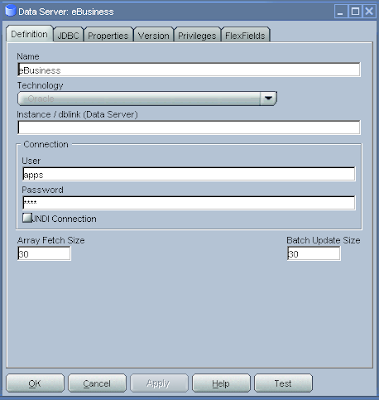
Create an Oracle Database Server to connect to Oracle eBusiness Suite schema, ‘apps’ in the Topology Manager:


2.Reverse Engineer
The next step is to reverse engineer the Oracle eBusiness schema, using the Oracle Data Integrator’s Reverse Engineering Knowledge Module for eBusiness Suite.

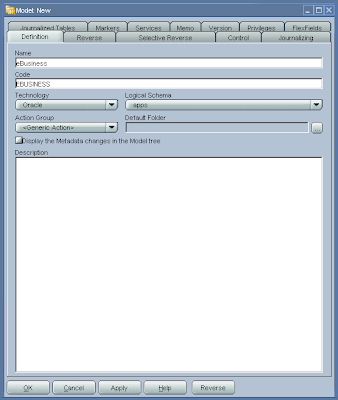
Create a new Model as follow, using Oracle as technology:


In the ‘Reverse’ tab, select ‘Customized’ and select the ‘RKM E-Business Suite XML to eBusiness’ knowledge module.


Before clicking ‘Apply’ select the ‘Application List’ and define the value of the list of application modules you want to reverse engineer. Remember also to select the ‘Types of objects to reverse-engineer’. If you forget to select the ‘View’ object, you would not be able to get a list open interface tables, as most of them are based on view objects. The value specified takes the form of ‘xxx’,’yyy’ if you want to specify multiple application modules to reverse engineer.

In our example we will use ‘SQLAP’.

A list of the available modules can be extracted by running a select query against the table ‘APPLSYS.FND_APPLICATION’.

select application_short_name from APPLSYS.FND_APPLICATION;

APPLICATION_SHORT_NAME
--------------------------------------------------
ABM
AD
ADS
ADS_DEV
AHL
AHM
ASG
....


Click on ‘Reverse’. Select the agent where the reverse engineering process would be executed.

Open the Operator utility and monitor the progress on the reverse engineering process, if required. This process can run a couple of minutes, depending on the implementation of the Oracle eBusiness Suite.


After the above process finishes, the Model will contain all the available interfaces and public tables for the selected module(s).


3.Integrate
Design your interface, for example reading an XML-file into the invoice open interface table.

On the flow tab of the designed interface, select the target. Change the IKM (Integration Knowledge Module) to ‘IKM E-Business Suite (Open Interface):


You will notice the configuration parameters at the bottom of the screen, starting with the OA_, and the ‘SUBMIT_PROGRAM’. These parameters are the information required by ODI to fire off a concurrent program in eBusiness Suite, after completion of the load of the data into the open interface table.

4.Execution
After execution of this interface, you would notice the new steps, which does the integration using the Oracle eBusiness Suite Concurrent Manager to suck in the information from the Open Interface Tables.


Thanks to PIETER MALAN. 

Tuesday, November 06, 2012